All Activity
- Past hour
-
 Light up your site with our Christmas Web Hosting Offer! Experience bodHOST for NVMe SSD speeds, DDoS protection, and scalable resources. Our 24/7 expert support ensures your website stays merry and bright! Elevate Your Hosting with Dedicated Server Hosting for lightning-fast speed, full root access, and advanced security! IN STOCK SERVERS - Washington DC: Single Intel Xeon E3-1230 CPU: 4 Cores / 8 Thread / 3.4 GHz Turbo Memory: 16 GB DDR3 Storage: 2x240GB SSD WI DISKS Bandwidth: 30 TB TRAFFIC Linux | Windows Managed 24x7 Support >>>>> Order Now! - 10% Discounted Price $82.80/mo Server: Single Intel Xeon E5-1620v4 CPU: 4 Cores / 8 Thread / 3.5 GHz Turbo Memory: 16GB RAM Storage: 2x240GB SSD WI DISKS Bandwidth: 30 TB TRAFFIC Linux | Windows Managed 24x7 Support >>>>> Order Now! - 10% Discounted Price $89.10/mo Server: Dual Intel Xeon 4214 CPU: 12 Cores/ 24 Threads / 2.2 GHz Turbo Memory: 64 GB DDR4 Storage: 2x480GB SSD WI DISKS Bandwidth: 30 TB TRAFFIC Linux | Windows Managed 24x7 Support >>>>> Order Now! - 10% Discounted Price $170.10/mo Server: Dual Intel Xeon 2630v4 CPU: 10 Cores/ 20 Threads / 2.2 GHz Turbo Memory: 32GB RAM Storage: 2x960GB SSD WI DISKS Bandwidth: 30 TB TRAFFIC Linux | Windows Managed 24x7 Support >>>>> Order Now! - 10% Discounted Price $170.10/mo Server: Dual Intel Xeon E5-2650v4 CPU: 12 Cores/ 24 Threads / 2.2 GHz Turbo Memory: 32GB RAM Storage: 2x 960GB NVMe Mix Use Bandwidth: 30 TB TRAFFIC Linux | Windows Managed 24x7 Support >>>>> Order Now! - 10% Discounted Price $224.10/mo For more details please, visit Dedicated Hosting: https://www.bodhost.com/web-servers/dedicated-servers Our Strength: - Secure, Reliable, Stable, and profitable hosting company - Dedicated Server Plan starts from $82.80/mo - Quality Assurance - 30 days money-back guarantee Payment Mode: Paypal, Credit & Debit Card If you have any questions, you can contact our sales department by initiating a chat by dropping an email to sales@bodhost.com or call us at 0844 324 5054.
 -
 Free trial — test the service risk-free and verify quality.
 - Today
-
 🎓Empower Academic Excellence with PYPROXY Join 2000+ universities and research institutions leveraging our 90M+ IP pool for groundbreaking discoveries ✅ Defeat anti-scraping mechanisms with dynamic IP rotation ✅ Secure global data access across 99% regions ✅ Full-stack support for Python/Java/Go/PHP/C++ projects 📩 Contact Lorena@pyproxy.com for academic partnership plans 🌐 http://www.pyproxy.com/
-
MonetizeBetter would like to wish all members celebrating their birthday today a happy birthday: davidrichard (33)Joanne Cesser (30)Garryy (33)UniSwap (54)SteusCreative (31)CNTEquipment (42)Dunnugran (30)Kinghyip (34)sophiedevine --,
-
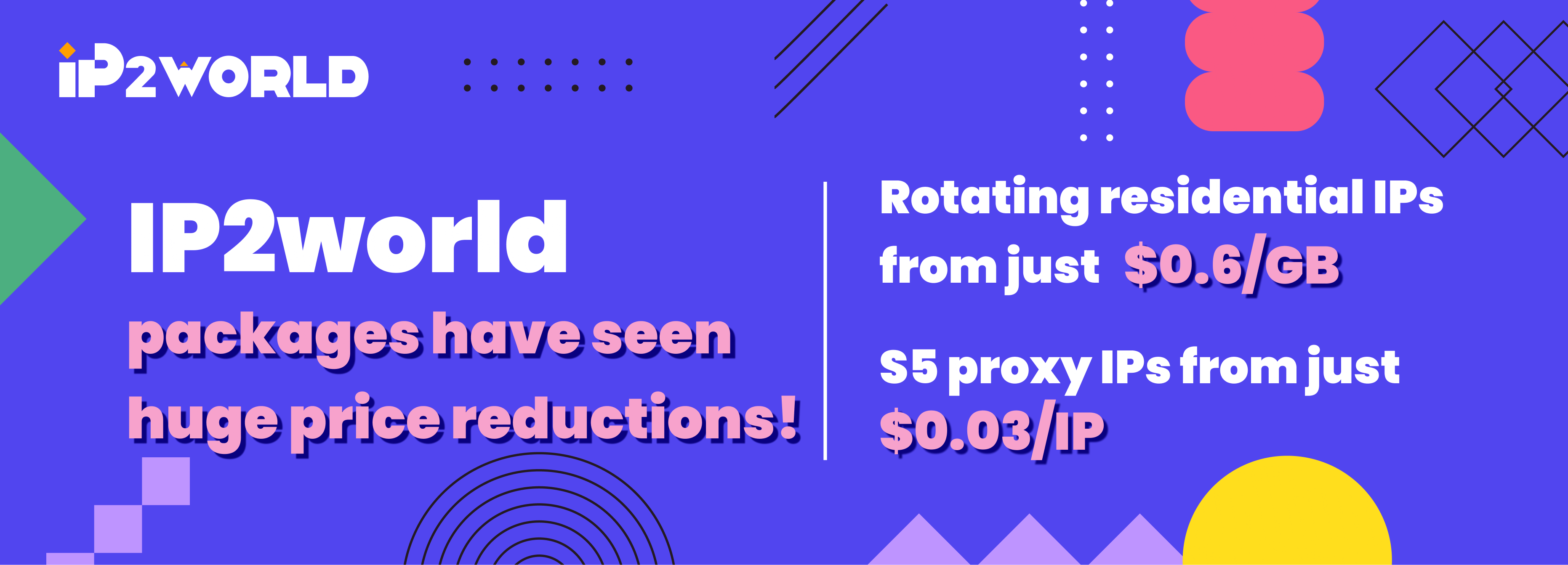
 ✨ Dynamic residential IP package starting at $0.6/GB, S5 package at $0.03 each! 📧 Contact us: service@ip2world.com 📱 WhatsApp: +852 5513 9884 🌐 To learn more, visit our website: ip2world.com
-
 NodeMaven — high-quality proxies for serious use cases. Residential and mobile proxies with a 30M+ IP pool, 99.98% uptime, and a 95.5% success rate on business tasks worldwide. Built for users who value stability, clean IPs, and predictable results. Premium quality, fair pricing, and a quality guarantee included. ---> https://nodemaven.com <----
 -
 Swisslayer dedicated servers, physically located in Switzerland, provide a stable and secure environment for hosting your web applications and storing your crucial data. Switzerland's private jurisdiction ensures that your business workload and privacy are exceptionally well-protected, offering a level of security and discretion that is hard to match. Equipped with top-of-the-line hardware and advanced security measures, our servers guarantee optimal performance and peace of mind. The robust infrastructure is designed to handle even the most demanding applications, ensuring seamless operation and reliable service. By hosting your servers in Switzerland, you benefit from both world-class performance and the assurance that your data is safeguarded by some of the strictest privacy laws globally. Check out SwissLayer.com Dedicated Servers Switzerland: X8 Turbo Blaze Servers CPU - Dual Intel Xeon X5670 RAM - 128GB DDR3 STORAGE - 1TB SSD BANDWIDTH - 100TB PORT SPEED - 10Gb/s DMCA IGNORED Price - $165.00/month CONFIGURE X10 Power Line Servers CPU - DUAL Intel E5-2680V4 RAM - 64GB DDR4 STORAGE - 1TB SSD BANDWIDTH - 100TB PORT SPEED - 10Gb/s DMCA IGNORED Price - $325.00/month CONFIGURE X11 ELITE Line Servers CPU - DUAL Intel Gold 6138 RAM - 64GB DDR4 STORAGE - 1TB NVME BANDWIDTH - 100TB PORT SPEED - 10Gb/s DMCA IGNORED Price - $450.00/month CONFIGURE X13 ULTIMATE Line CPU - DUAL Intel Gold 6430 RAM - 64gb DDR4 STORAGE - 1TB NVME BANDWIDTH - 100TB PORT SPEED - 10Gbps DMCA IGNORED Price - $750.00/month CONFIGURE GPU PRO Servers CPU - DUAL Intel E5-2680V4 RAM - 64GB DDR4 STORAGE - 1TB SSD BANDWIDTH - 100TB PORT SPEED - 1Gb/s DMCA IGNORED Price - $290.00/month CONFIGURE AMD EPYC Force CPU - DUAL AMD Epyc 7452 RAM - 64GB DDR4 STORAGE - 1TB SSD BANDWIDTH - 100TB PORT SPEED - 10Gb/s DMCA IGNORED Price - $430.00/month CONFIGURE Take a look at SwissLayer.com Extreme Bandwidth Servers: X10 Unmetered Serves CPU - Dual Intel Xeon E2690V4 RAM - 128gb DDR4 DRIVES - 1TB SSD UPLINK - 10Gb/s Guaranteed MONTHLY BANDWIDTH - UNMETERED DMCA IGNORED Price - $850.00/month CONFIGURE EPYC High-Bandwidth Servers CPU - Dual AMD EPYC 7452 Processors RAM - 128gb DDR4 DRIVES - 1TB NVME UPLINK - 25Gb/s Guaranteed MONTHLY BANDWIDTH - UNMETERED DMCA IGNORED Price - $2200.00/month CONFIGURE X11 High Extreme Bandwidth Server CPU - Dual Intel GOLD 6138 RAM - 128gb DDR4 DRIVES - 1TB NVME UPLINK - 40Gb/s Guaranteed MONTHLY BANDWIDTH - UNMETERED DMCA IGNORED Price - $2500.00/month CONFIGURE Our high-performance Swiss dedicated servers provide the best of both worlds: the power and reliability of dedicated hardware, combined with the flexibility and scalability of the cloud. Featuring enterprise-grade hardware and ultra-fast internet connections via 1Gb/s, 10Gb/s, 40Gb/s, and 100Gb/s networks, these servers ensure optimal performance and speed for even the most demanding applications. Additionally, the ability to easily scale up or down as needed makes our dedicated servers perfect for businesses of all sizes, offering a robust solution that grows with your needs. We currently accept Paypal, credit cards in addition to a wide range of cryptocurrencies. As crypto privacy enthusiasts we pride ourselves on offering Swiss Tailored web hosting services. Swiss Layer makes it easy all digital transactions are automated within our customer portal. We have added TWO new payment gateways: Cryptomus and Heleket. These two accept over 112 coins. This includes USDT (not accepted before) and many others. If the digital coin you would like to checkout with is not listed below send us an email and we can add your preferred digital coin at checkout. The full list of the over 170 supported altcoins can be found Here: Accepted Payment Methods. Contact us via web chat today and save on all our premium Swiss hosting products. We take pride in our satisfied customer base and strive to maintain it by consistently delivering exceptional hosting services. Our team of highly trained engineers is available 24/7 to address any sales or support inquiries you may have. Data Center: Zurich, Switzerland Phone: +41-43-550-7863 E-mail: support@swisslayer.com
 -
 Discover our dedicated servers offers : https://rdp.monster/dedicated-servers Need a domain name? Check out our prices now: https://manager.rdp.monster/order/domain 🌐 Would you like to become a reseller or an affiliate (15% to 50% commission)? https://rdp.monster/become-vps-reseller
 - Yesterday
-
 Active & Taking Orders!
 -
 tylerjhon joined the community
 -
 🎰 Game Collection for Creatives 2025 Are your creatives burned out? Time to test new approaches! We've compiled 7 new and not-so-new games from various providers. Some of them have already been spotted in SPY services, while others are promising new releases for testing 👇 ➡️ Read: Game Collection for Creatives 2025 Inside: Chicken VS Zombies, King Kong Cash, Forest Arrow, Fish Road, Fowl Gold Play, Ice Fishing, Chicken Royal #creatives #games | Magic Click | Ask our team a question
 -
 The Pump.fun live-stream craze is definitely fascinating, but as highlighted, the risks are significant with short-lived hype and streamer-dependent tokens. For those looking to explore live-streaming apps safely, the onstream download provides a reliable platform for streaming and watching live content without engaging in high-risk token ecosystems. It offers a smooth and user-friendly experience, making it easier to follow trending streams and enjoy live events. This platform ensures uninterrupted access to a variety of live content, giving viewers a safer and more stable way to enjoy streaming without exposure to the extreme volatility seen in crypto-based live streams.
 -

Right server is needed in Europe ...
Nicole replied to RolandNixon's topic in Hosting & Domain Providers
Looking for a scalable, secure, and fast VPS? OwnWebServers is now offering 50% OFF all VPS plans when you use code VPS50 at checkout. Ultra-Fast SSD Storage Full Root Access 24/7 Support DDoS Protection Get business-ready hosting with instant setup and outstanding value. Get Started: https://ownwebservers.com/vps-cloud-server/ -
 16-12-2025 - НАША ТЕМА АКТУАЛЬНА! ОБРАЩАЙТЕСЬ ПО КОНТАКТАМ, УКАЗАННЫМ НИЖЕ ~ 12-16-2025 - OUR TOPIC IS RELEVANT! CONTACT US BY THE CONTACTS BELOW ~ LinksTXTboto save: Patolus.chat (Owners contact methods) LimitlessTXT.com/ LimitlessSIP.com/ Main channel: https://t.me/+sPdzGgHAQ7E3YjE0 Support: https://t.me/LimitlessContactBot
 -
 All emails available! Contact now! Session ID : 05ad120de91dd750c0a6c8c92ecf2946d93d0c0e728957afafd1e66e4d83745038 Signal: Governer.96 Telegram: @Governerr | Governer Message me on Session or Signal for a Free Vouch Copy
 -
 16-12-2025 - НАША ТЕМА АКТУАЛЬНА! ОБРАЩАЙТЕСЬ ПО КОНТАКТАМ, УКАЗАННЫМ НИЖЕ ~ 12-16-2025 - OUR TOPIC IS RELEVANT! CONTACT US BY THE CONTACTS BELOW ~ Website: SagaSMS.com Telegram Channel: https://t.me/SagaSMScom Telegram Owner: @SagaSMS
 -
Virtual private server (VPS) is a service that makes available a ready-to-use virtual server fully configured and managed by experts for use. The reason behind the high popularity of this service is the fact that not everyone today can afford to buy high-quality server hardware, which is quite expensive. With VPS hosting, the user gets a full-fledged but virtual server, equipped with an operating system and has all the possible access rights to manage the operating system. On this server, the user can install any software and host any number of sites. With hardware virtualization, this server will be strictly isolated from other similar servers, provided with absolute information security, while still using the same set of hardware by different kernels, such as video cards, network cards, a variety of disks, and others. NVMeVPS Hosting: https://regvps.com/linux-vps/ NVMeVps1 $3.95 CPU 2хE5-2680v4 Dedicated RAM 1 GB Virtualization KVM Disk Space NVMe 10GB RAID -10 Yes Setup Fee Free Bandwidth 1 TB per Month Location USA - Los Angeles, Germany, Switzerland, Russia Port/Uplink 10 Gbit/s SolusVM Yes NVMeVps4 $15.80 CPU 4хE5-2680v4 Dedicated RAM 4 GB Virtualization KVM Disk Space NVMe 30GB RAID -10 Yes Setup Fee Free Bandwidth 4 TB per Month Location USA - Los Angeles, Germany, Switzerland, Russia Port/Uplink 10 Gbit/s SolusVM Yes Check the additional parameters here: NVMe VPS Check the additional parameters here: Dedicated Server To order: RegVps In addition to the main package, you can order the following services: ISPmanager lite – free of charge. ISPmanagerPro – $ 25/month cPanel - $ 35/month Additional IP - 2$/month. Additional NVMe 10Gb- $ 5/month Full list of fares: Regvps Our contacts: Website: https://www.regvps.com/ Contacts: Open a ticket
-
 AlexCross joined the community
 -
 SMM without proxies is a direct path to bans Social networks tightly link accounts by IP, device, and fingerprints. Managing 10–50+ profiles without proxies leads to blocks, shadowbans, and mass bans. To: — Manage multiple accounts without risk — Avoid “hacked account” triggers and geo anomalies — Work stably from an office or as a freelancer — Scale an agency safely 👉 Use anti-detect browsers and static residential or mobile proxies 🔥 What’s inside: — How anti-fraud systems detect multi-accounting — Why 1 account = 1 profile = 1 proxy — Why datacenter proxies are a bad choice for SMM — The best proxies for SMM and building a secure infrastructure Full breakdown in our new article
 -
bodHOST's holiday miracle is here! Searching for cheap dedicated server hosting? Get an instant 10% OFF this Christmas Speed Boost. With powerful hardware, crush high-traffic spikes and handle resource-intensive apps throughout the festive rush. Get your speed at a Christmas price!
-
 #SEC #Crypto Over the past few days, the U.S. Securities and Exchange Commission (SEC) has been extremely active in the crypto sector. In particular, with the convening of events such as the sixth crypto roundtable and the fourth Investor Advisory Committee meeting, SEC Chairman Paul Atkins has delivered multiple speeches addressing the crypto space, covering areas including privacy, custody, regulation, and AI. If one were to use a single word to summarize the SEC’s recent actions in the crypto domain, it would be neither “tightening” nor “loosening,” but reconstruction. On the surface, the SEC is still talking about risks, custody, and investor protection. But put another way, the SEC is no longer trying to suppress the crypto industry using traditional financial templates. Instead, it has begun to consider a more realistic question: under the irreversible trend toward on-chain systems, where should regulation actually position itself? The core of this shift does not lie in any single specific rule, but in the regulatory philosophy itself. Click to register SuperEx Click to download the SuperEx APP Click to enter SuperEx CMC Click to enter SuperEx DAO Academy — Space Development 1: Privacy and Security — The SEC Publicly Acknowledges for the First Time That “Regulation May Have Gone Too Far” In recent public remarks, the SEC Chairman used a striking and rare analogy: if regulatory approaches are mishandled, blockchain technology could be distorted into “the most powerful financial surveillance system in history.” This was not an emotional statement, but a highly consequential boundary warning. Blockchain’s transparency was originally designed to reduce trust costs, improve settlement efficiency, and reduce intermediary friction. But if regulatory logic evolves into the following: every wallet is treated as a potential broker every line of code is treated as a trading venue every on-chain transfer is presumed to require prior or subsequent reporting then blockchain’s technical advantages would be completely reversed into a form of infrastructure that is “natively auditable, inescapable, and permanently traceable.” This touches on a long-avoided question: does compliance necessarily mean total visibility? This shift in the SEC’s stance releases at least three important signals: First, regulators have realized that “technology neutrality” cannot remain at the level of slogans. If regulatory outcomes completely contradict the original intent of the technology, that is not neutrality, but misuse. Second, privacy is no longer being treated as the “opposite” of regulation. The previous narrative was: the stronger the privacy, the harder the regulation. The narrative is now beginning to shift toward how regulation can function without sacrificing privacy. Third, regulators are beginning to acknowledge that over-compliance itself is a form of systemic risk. This is the first time in many years that the SEC has so clearly left room, in a public context, for the concept of “regulatory self-restraint.” Development 2: Crypto Asset Custody — The SEC Delivers a Long-Overdue Basic Lesson for Retail Investors Note: On December 12, the U.S. SEC officially published guidance aimed at retail investors on the fundamentals of crypto asset custody, to help them decide how to hold crypto assets in the best possible way. If discussions around privacy and surveillance are more macro-level, then the SEC’s recently released guidance on crypto asset custody is clearly a practical response directed at ordinary investors. This content appears basic on the surface, but its significance is substantial. It does not discuss whether tokens are securities, nor does it touch on enforcement intensity. Instead, it returns to the most fundamental — and also the most failure-prone — aspect of the crypto world: how do you actually “hold” crypto assets? In traditional finance, this question almost does not exist. When you hold stocks, custody is handled by banks, brokers, and custodians. But in the crypto world, the SEC has for the first time clearly stated, in official language, a simple fact: wallets do not store assets, they store private keys. If the private key is lost, the asset effectively ceases to exist. Behind this statement lies a subtle shift in regulatory attitude. In the past, regulators tended to attribute risk to “market immaturity,” “project fraud,” or “technical vulnerabilities.” Now, the SEC is increasingly directing risk attribution toward institutional design itself — including whether regulatory boundaries have been overstepped, whether compliance frameworks have distorted technological forms, whether privacy has been excessively sacrificed, and whether overly centralized regulation is creating new forms of systemic risk. Especially in its comparison between self-custody and third-party custody, the SEC did not simply side with one model. Instead, it repeatedly emphasized a practical reality: self-custody gives you absolute control, but also absolute responsibility third-party custody lowers operational complexity, but introduces credit and bankruptcy risk This is not an endorsement of centralized platforms, but a reminder to investors that there is no “risk-free option” in the crypto world — only choices with different risk structures. More importantly, the SEC repeatedly referenced issues such as privacy protection, data usage, rehypothecation, and commingling of assets in this guidance. In reality, this is laying the conceptual groundwork for more granular custody regulation in the future. Regulatory logic is shifting from “punishing illegal behavior” toward “standardizing infrastructure behavior.” Development 3: On-Chain Capital Markets — The SEC Is Redefining “What Counts as Innovation” What truly captured market attention was the SEC’s recent systematic statements around blockchain, tokenization, and AI. At the fourth Investor Advisory Committee meeting in 2025, SEC Chairman Paul Atkins delivered a highly anticipated speech. This address was not only his annual summary-style remarks, but also a systematic articulation of the future development path of U.S. capital markets. If one focuses only on keywords, it would be easy to misinterpret the speech as “the SEC is embracing blockchain.” A more accurate interpretation is that the SEC is not relaxing regulation, but redefining its boundaries and methods. In the relevant remarks, the SEC clearly conveyed one position: the issue is not “on-chain versus off-chain,” but whether market efficiency, transparency, and the quality of investor protection are improved. This directly rejects the previous blunt regulatory approach of forcing all on-chain protocols into outdated definitions of “exchanges” or “brokers.” The SEC also, for the first time, systematically distinguished between several different tokenization pathways: natively issued on-chain securities structures that map traditional asset rights onto the blockchain synthetic products that only reflect price and do not involve ownership rights This distinction itself signals that regulation is no longer attempting a one-size-fits-all approach. Even more noteworthy is the SEC’s explicit mention of making good use of exemptions and transitional frameworks to provide experimental space for on-chain finance. Behind this lies a very pragmatic judgment: if U.S. regulation does not leave windows for innovation, innovation will not disappear — it will simply relocate. Development 4: AI × Crypto — Regulators Do Not Want to Repeat the Mistake of “Over-Checklist Regulation” On the topic of AI, the SEC’s attitude is equally revealing. As companies enthusiastically embrace AI, the SEC has not chosen to issue a long list of “mandatory disclosure items,” but has instead emphasized continued adherence to the principle of materiality. This reflects a reassessment of past regulatory experience. Overly detailed disclosure checklists often lead to two outcomes: mechanical compliance by companies resulting in distorted information, and regulatory fatigue where rules rapidly become outdated due to the pace of technological change. The SEC clearly does not want to replicate this failed path in the overlapping domain of AI and crypto. Regulators are beginning to acknowledge that the pace of technological change has already become too fast to be covered by exhaustive rules. Therefore, rather than prescribing “what you must do,” it is more effective to return to a more fundamental question: does this technology materially affect your business, risks, and financial condition? This represents a clear “return to principles.” Conclusion: Regulation Is No Longer Trying to Be a “Roadblock” When these developments are viewed together, a clear trend emerges: the SEC is actively trying to shed its role as the “opposition to innovation.” It continues to emphasize investor protection, market integrity, and compliance boundaries, but the approach is changing — from “expanding definitions and compressing space” to “clarifying boundaries and releasing flexibility.” For the market, this does not mean that risk has disappeared, nor does it signal deregulation. But it does mean that the crypto industry is entering a stage where it can be discussed, designed, and institutionalized. The real test lies not in what regulators say, but in whether, over the next few years, these ideas can be translated into rules that are executable, predictable, and do not excessively drain innovative energy.
 -
 logicalshz joined the community
 -
 Bumping the thread. Our service is running without interruption, and support is available. Feel free to ask any questions — we’ll assist promptly.
 -
#Solana #Sol Solana can be considered a miracle. You will find that there are very few public blockchains like Solana that rose rapidly, then experienced extreme moments of brilliance, and also endured collective doubt. It was once called an “Ethereum killer,” and it was once sentenced to “death” because of outages and the collapse of FTX. But in 2024–2025, it once again stood at the center of the stage, becoming one of the most active main battlefields for Meme, DePIN, NFT, PayFi, and AI Agent ecosystems. What exactly is Solana? Why can it be outrageously fast? And why can it never escape the controversies around “centralization” and “stability”? In this article, we will explain everything clearly in one go. Solana Explained Clearly in One Sentence Solana is a Layer 1 public blockchain whose core design goal is “extreme performance first.” To put it in even more straightforward terms: what Solana wants to be is a Layer 1 public blockchain that is as fast as Web2, but still runs on blockchain infrastructure. It was not born for “store of value.” From the very beginning, it targeted heavy scenarios such as high-frequency trading, payments, and large-scale on-chain application execution. Solana’s “Speed” Is Not About TPS, but About the “Extremeness” of Its Architectural Choices When many people talk about Solana, they always end up focusing on one number: TPS is very high, at the level of hundreds of thousands or even millions. But if you only stare at TPS, you are actually underestimating Solana’s real value, and also misunderstanding the source of its controversies. The essence of Solana is not “slightly optimizing performance,” but making a complete set of architectural trade-offs at the blockchain base layer that are entirely different from Ethereum. What it pursues is not “finding a balance between decentralization, performance, and security,” but making a clear choice: performance first, and then using engineering methods to backstop the other issues. 1. Proof of History: Taking “Time” Out of Consensus In most blockchains, “time” itself is an extremely costly thing, because nodes do not know who saw a transaction first. They can only rely on: continuous communication repeated reconciliation multiple rounds of voting to confirm transaction ordering. Solana’s Proof of History does something very counterintuitive: it no longer lets the entire network negotiate time. Instead, it generates an unfalsifiable timeline in advance. Through a Verifiable Delay Function (VDF), it continuously produces a hash chain, where each hash naturally represents that a certain amount of time has already passed. What does this mean? Once a transaction enters the network, it can be “pinned” to a specific point in time. Validators only need to verify whether the order is correct, rather than renegotiating the order. This dramatically reduces the communication complexity at the consensus layer. This step is not “speeding up consensus,” but reducing the amount of work that consensus itself needs to do. So Solana is fast not because nodes are more diligent, but because it makes nodes do much less work. 2. Sealevel Parallel Execution: Not a Faster EVM, but “Not EVM” Solana’s second core component is the Sealevel parallel execution engine. In the EVM world, most transaction logic is implicit: contracts decide by themselves which state they read and write, and nodes can only execute transactions sequentially to avoid state conflicts. This leads to one result: even if two transactions are completely unrelated, they still have to queue. Solana instead requires transactions to “declare first, then execute.” Transactions must declare in advance which accounts they will read and which accounts they will write. Validators can determine conflicts ahead of time, and if there is no conflict, transactions can be executed in parallel. This allows Solana to truly utilize modern servers’ multi-core CPUs, instead of only using a small portion of computing power like traditional blockchains. This is also why Solana is particularly suitable for: high-frequency DEXs order books on-chain matching real-time games and payments It does not treat the blockchain as merely a “settlement layer,” but attempts to treat it as a high-performance state machine. 3. Trading Hardware for Performance: This Is a Design Choice, Not a Technical Flaw Solana’s biggest point of controversy is actually very simple: high node requirements — high bandwidth, high memory, high IO, and high compute power. This directly leads to: slower growth in the number of validator nodes difficulty for ordinary users to run nodes themselves it being more easily questioned as “centralized” But one thing must be distinguished clearly: is this an “unavoidable compromise,” or an “active choice”? The Solana team’s logic has always been very clear: hardware will continue to improve, while software bottlenecks are extremely difficult to break. Rather than limiting the upper bound in order to accommodate low-performance devices, it is better to raise the upper bound directly and run the network at the real-world limits of hardware. You may disagree with this path, but it is not laziness. It is an extremely aggressive engineering decision. 4. In Summary, Solana’s Speed Comes From Three Things Using PoH to reduce consensus communication costs Using Sealevel to achieve true parallel execution Using hardware specifications in exchange for system throughput The costs are equally obvious: higher operational complexity stricter engineering stability requirements extreme sensitivity to clients, networks, and synchronization mechanisms This is also why Solana experienced multiple outages in its early stages. This was not a design failure, but rather problems being exposed earlier under extreme conditions. Solana’s True Positioning: Not Ethereum 2.0, but On-Chain Web2 If Solana must be given an accurate positioning, it is more like a “high-performance application platform” in the blockchain world, rather than a financial settlement layer. What does this mean? it is more suitable for large user bases and high-frequency interaction it is more suitable for Meme, NFT, payments, and DePIN it does not pursue extreme decentralization it accepts a certain degree of engineering compromise This is completely different from Ethereum’s philosophy, but it does not conflict with it. Solana’s Explosion Was Not Driven by VC, but by “Real Usage” Some people ask why the Solana ecosystem was able to explode again in 2024–2025. In fact, many people overlook one point: Solana’s explosion was not driven by VC, but by real usage. 1. Memes Brought Real Transaction Volume low gas fees second-level confirmation retail-user friendly These factors made Solana the most natural breeding ground for Memes. Many Memes are not “high-end,” but they brought real on-chain transaction volume, fees, and active addresses. 2. NFTs Shifted From “Art” to “Consumer-Grade Applications” The advantages of Solana NFTs lie in: extremely low minting costs user experience close to Web2 better suitability for large-scale issuance This allows NFTs to no longer remain mere collectibles, but begin evolving toward consumer-grade applications such as: tickets memberships in-game assets 3. PayFi and Stablecoin Transfer Scenarios USDC and USDT transfers on Solana are: almost imperceptible extremely low cost excellent in user experience In emerging markets, Solana has in practice already taken on part of the role of payment infrastructure. Unavoidable Controversies: Talking About Solana Cannot Only Focus on the Positive Side ❌ Outage history Solana has repeatedly experienced: network congestion block production halts validator restarts For “financial-grade infrastructure,” these are serious flaws. ❌ High validator threshold high hardware costs high degree of specialization relatively concentrated validator distribution This has long caused Solana to be questioned in terms of its degree of decentralization. ❌ Strong engineering orientation rather than extreme security orientation Solana’s choice is essentially: get applications running first, then talk about perfect security. This is an engineering philosophy, not a mistake, but it is not something everyone can accept. Conclusion: Solana’s Value Lies in the Fact That It Is Truly Being “Used” In the crypto industry, many narratives exist only in PPT slides, while Solana’s value is reflected more in on-chain data. It is not perfect, but it is real, aggressive, and efficient. For developers, it is a tool; for users, it is an experience; for the market, it is a choice. And choice itself is the most important meaning of the crypto world.
-
 Meet the new location US Massachusetts, Boston (AT&T) Includes managed IP rotation, unlimited traffic, and UDP support for Socks5 and VPN. Support: @detect_support_bot
 -
 robertambrose892 joined the community
 -
 trapstarbag joined the community
 -
MonetizeBetter would like to wish all members celebrating their birthday today a happy birthday: amanwaa (27)Jonny5 (45)johnnnas (40)Scarlet (40)sonu041 (20)eCommerce Advisers (48),
-
NodeMaven — high-quality proxies for serious use cases. Residential and mobile proxies with a 30M+ IP pool, 99.98% uptime, and a 95.5% success rate on business tasks worldwide. Built for users who value stability, clean IPs, and predictable results. Premium quality, fair pricing, and a quality guarantee included. ---> https://nodemaven.com <----
- Last week
-
🔥 TOP PROXIES OF THE WEEK 🔥 Every week we select the most stable and reliable players — those who deliver the best results in speed and anonymity. This week’s top picks: 🇵🇭 PH Zenlayer (Residential) — The Philippines break into the ranking: rare IPs and stable performance. 🇪🇸 ES Lietpark Communications (Residential) — Spain confidently holds its position: clean IPs and a high level of trust. 🇺🇸 US CAMPLINK (Residential) — The USA with a reliable pool: stability and excellent compatibility for any tasks. 🇵🇪 PE Lietpark Communications (Residential) — Peru in the top: working and rare residential IPs. 🇦🇹 AT Lietpark Communications (Residential) — Austria demonstrates consistency: high-quality IPs with excellent pass rates. ⚡️ These proxies delivered maximum performance this week and rightfully earned their spots among the leaders. Test them right now — only top-tier solutions from CyberYozh App