 MonetizeBetter We Help You Monetize Better Your Digital Assets! 💰👍


Back in 2022, I built a list of 100 blogs that the whole “make money online” world held up as proof the model worked. The six-figure income reports. The ones people screenshotted onto vision boards.
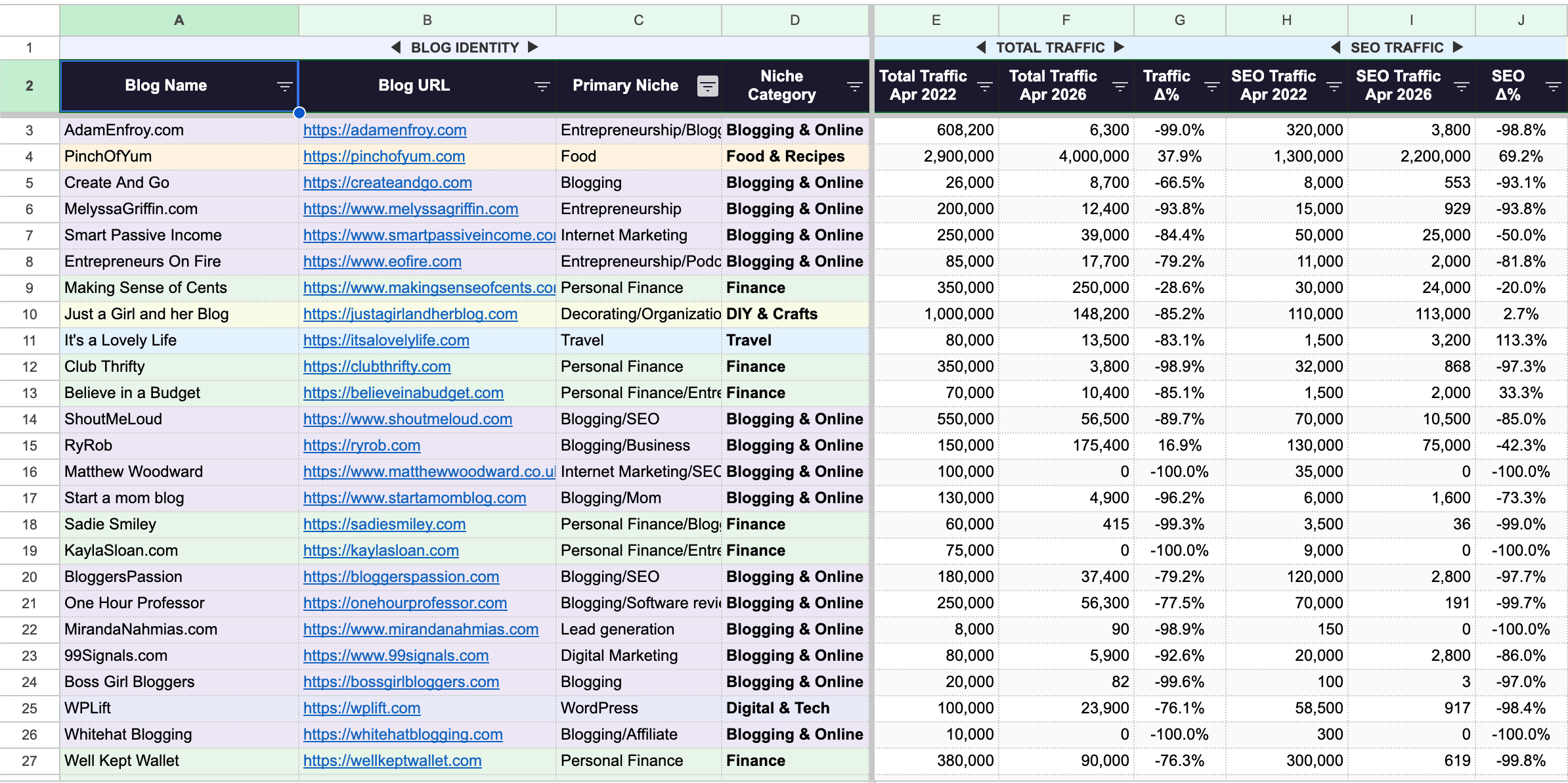
I reviewed all 100 past success stories and tracked how their organic search traffic changed from 2022 (when I first tracked their income) to 2026. The hard truth is that the median blog has now lost about 85% of its organic traffic. However, 21 of the 100 blogs are still growing, and I’m going to share with you today what those 21 have in common. You can read the full study on my personal website: The Great Blogging Collapse: What Happened to 100 Successful Blogs? [Study]
Key takeaways
- Of the 100 blogs that were successful in 2022, only 21 grew their organic traffic by 2026.
- The median blog lost about 85% of its organic traffic. Half the list did worse than that.
- Scale protected no one. The median decline remained around 85% across all size bands, from sub-50k to 500k+ sites. Getting big bought you nothing.
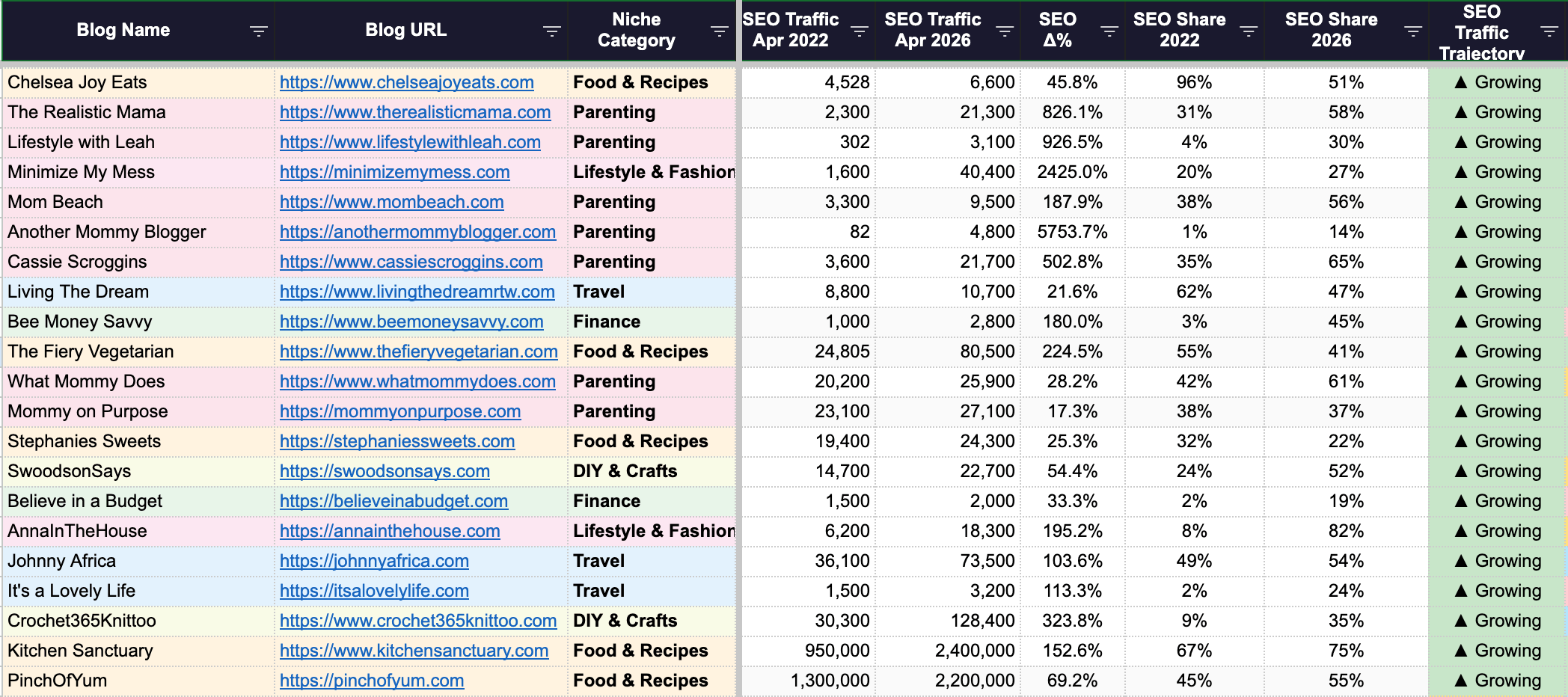
- Only one niche held its ground: DIY & Crafts, with a median close to flat — but it’s bimodal. Four of the six DIY sites grew (Crochet365Knittoo quadrupled), while two still collapsed 90%+. The breakout winners carried the sector; the median DIY site barely held the line.
- The “make money blogging” niche is now effectively dead: a median of roughly −93%, and not a single blogging/make-money site in the cohort grew. The niche that taught the model could not survive it.
MonetizeBetter, back when it was Monetize.info, was on that list, and we got hit like everyone else. So I’m not writing this from the cheap seats. I was holding a couple of these blogs myself. Here’s what the data actually says, and what I’d do about it if you’re sitting on a blog right now.
What and how I measured in the study
The full 100-blog dataset, with traffic for each site, is available here. This is a cohort study, not a representative sample. I am not claiming that two-thirds of all blogs on the internet lost their traffic. I am claiming something narrower and harder to wriggle out of: of the specific blogs publicly celebrated as the model’s biggest winners, two-thirds lost the majority of their traffic.
What killed blogs as a business
Two waves, with the same root cause.
- First, Google’s Helpful Content Update (Sept 2023) and the March 2024 core update, which Google itself said reduced low-quality, unoriginal content in search by about 45%. Independent publishers got flattened. HouseFresh alone lost 91%. (Hold that name — it comes back later, and the comeback is the whole point.)
- Then, AI Overviews went from an experiment to the default. By early 2026, they show on roughly half of searches, and Ahrefs measured them cutting clicks to the #1 result by about 58%. Most searches now end with zero clicks, so the user gets the answer and never leaves Google.
Both waves punished the same thing: summarizable content. A “best budgeting apps” post is exactly what an AI Overview hands the user in three sentences without a click. If your content can be summarized, it will be, and you won’t get the traffic.
What niches have been affected the most
The collapse sorted on one variable: how much the content required you to do something a machine can’t fake. I call it irreplaceability.
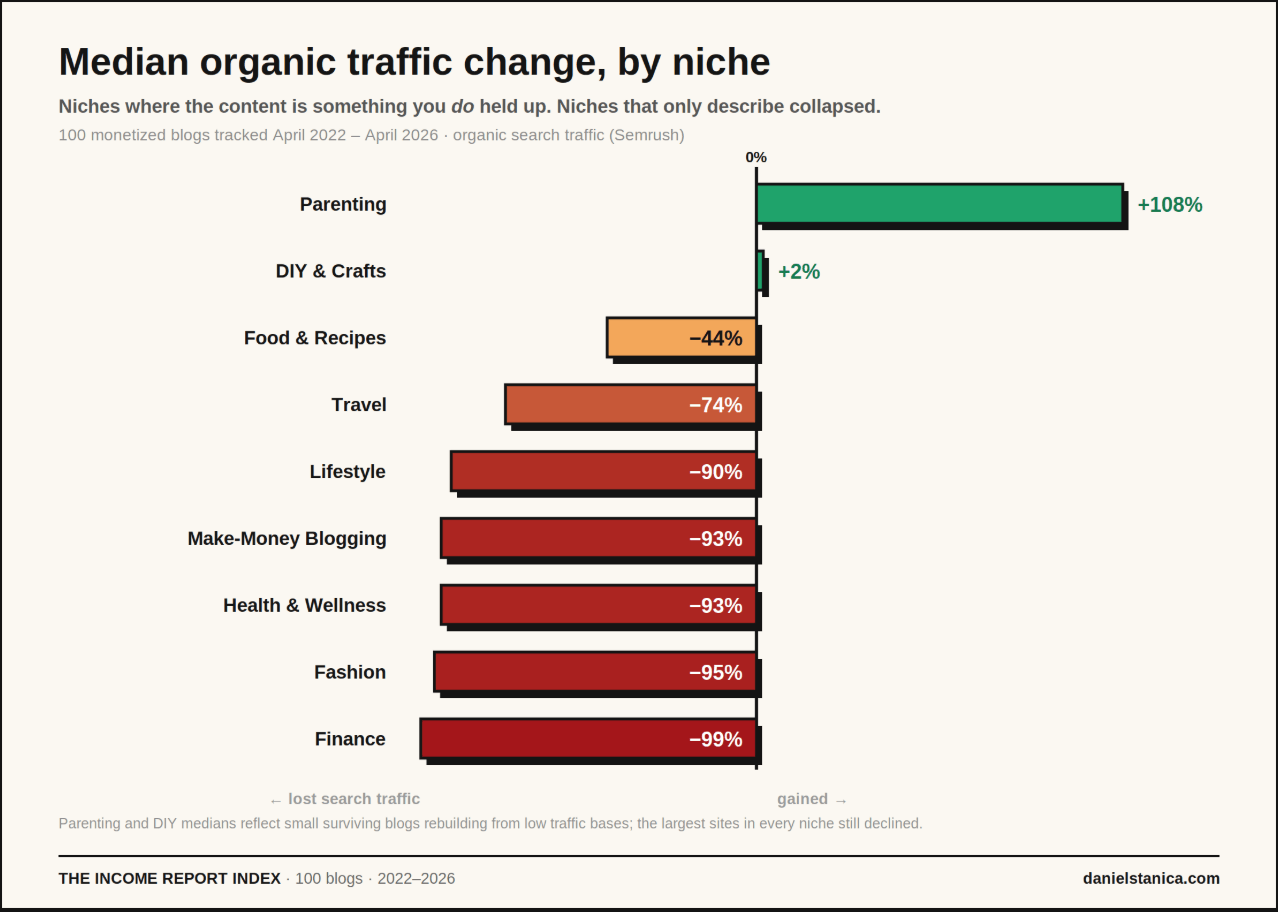
Here’s the median change in organic search traffic for each niche, straight from the dataset:
| Niche | Blogs | Median organic traffic change (2022 → 2026) |
How many grew |
|---|---|---|---|
| Parenting | 10 | +108% | 7 |
| DIY & Crafts | 6 | +2% (≈ flat) | 4 |
| Food & Recipes | 14 | −45% | 5 |
| Travel | 12 | −74% | 4 |
| Lifestyle & Fashion | 9 | −90% | 2 |
| Health & Wellness | 3 | −93% | 0 |
| Blogging / Make money online | 20 | −93% | 0 |
| Finance | 21 | −99% | 2 |
(Median organic search traffic change, April 2022 to April 2026, per the 100-blog dataset. “Other” and a lone Digital & Tech site sat between −95% and −98%.)
- The make-money-online niche, fittingly, could not make money online.
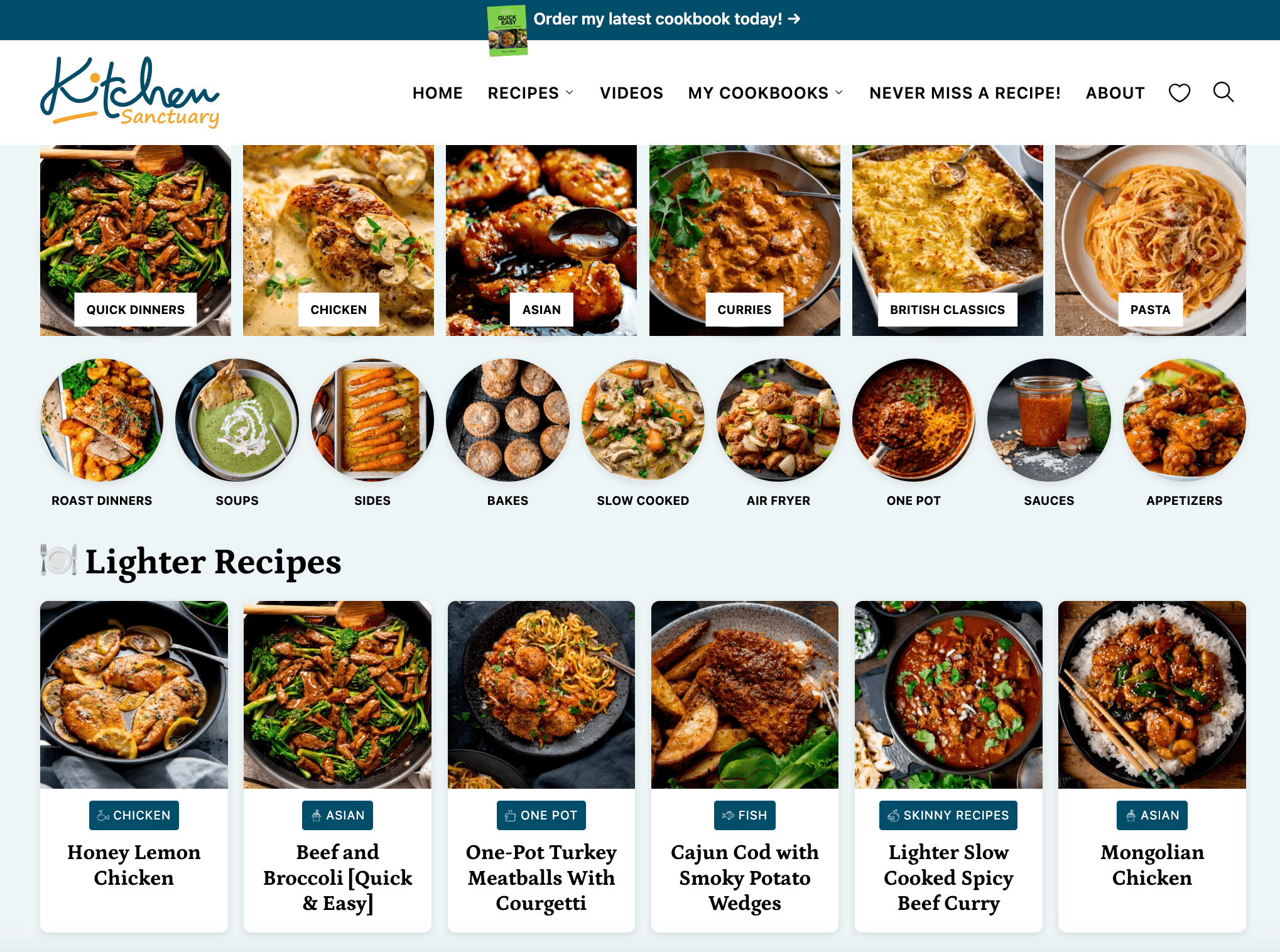
- Food is the cleanest proof. A recipe is something you actually cooked and comes with the photos, the timing, and the “this looks too thin, keep going.”
- Kitchen Sanctuary grew from 950K to 2.4M organic visits and turned it into two cookbooks. Pinch of Yum went from 1.3M to 2.2M.
A crochet site, Crochet365Knittoo, quadrupled, because a pattern you tested stitch by stitch is the purest “content is the doing” there is.
The niches that died described things instead of doing them. Generic finance at −99%: “How to build an emergency fund” is now a three-sentence AI answer. Health at −93%: summarizing medical consensus has no moat. Fashion at −90%: one “spring capsule wardrobe” post is interchangeable with ten thousand others.
There was no safe niche. There was only safe content.
What kind of blogs survived
What actually survives is content that demonstrates firsthand experience a machine can’t fake, distributed to an audience you own, ideally tied to a real product and a real brand name people search for.
Every survivor in the dataset has at least two of those four traits. The thrivers have three or four.
Remember HouseFresh?
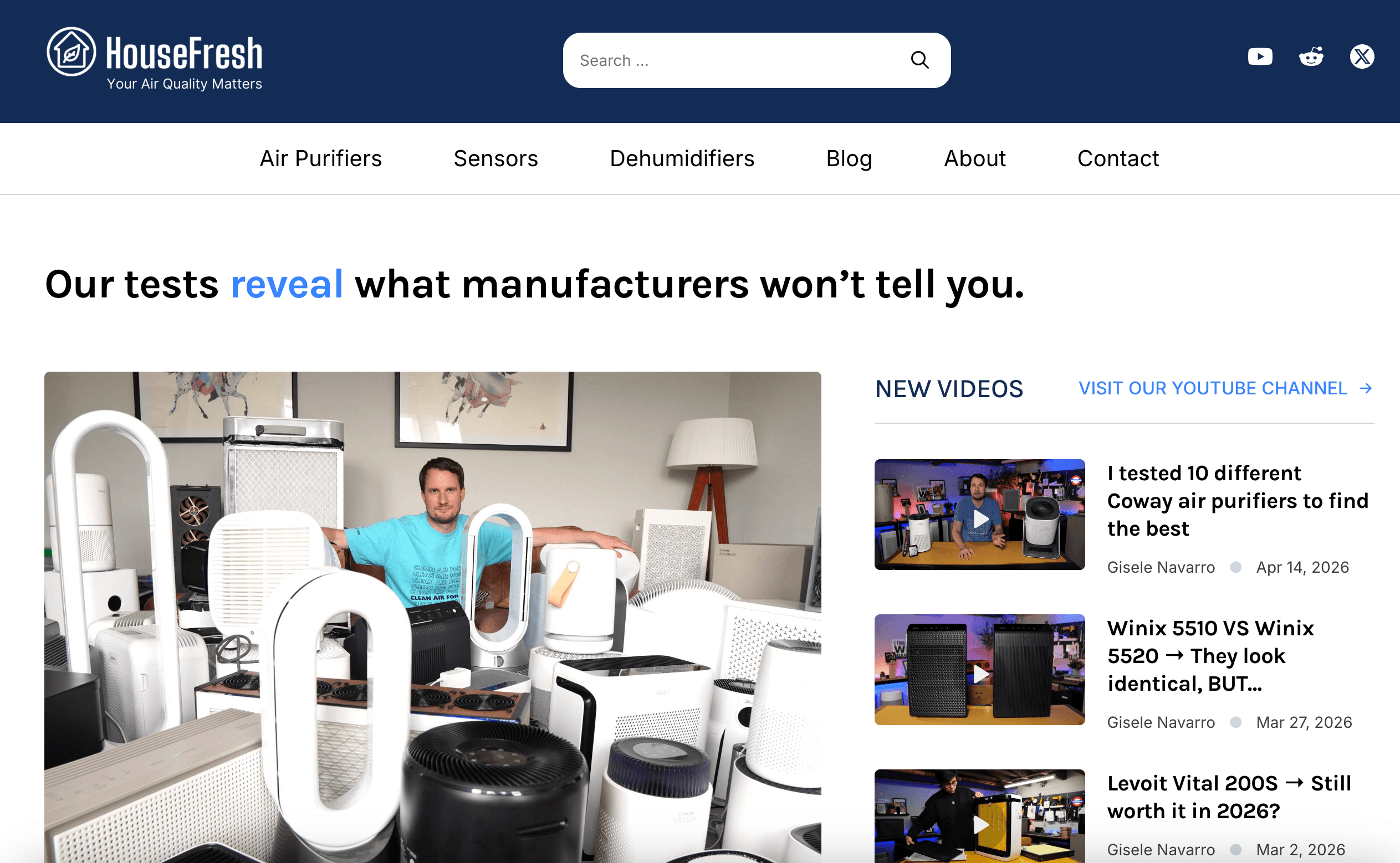
The air-purifier review site that lost 91% of its Google traffic after the Helpful Content Update became the poster child for everything wrong with the algorithm.
Here’s the part I promised you: in October 2025, managing editor Gisele Navarro announced that its traffic hadn’t just recovered but had surpassed its pre-HCU peak. There was no technical silver bullet. They doubled down on hands-on product testing, built a YouTube channel, collaborated with Linus Tech Tips, and went on podcasts, basically building the brand off Google.
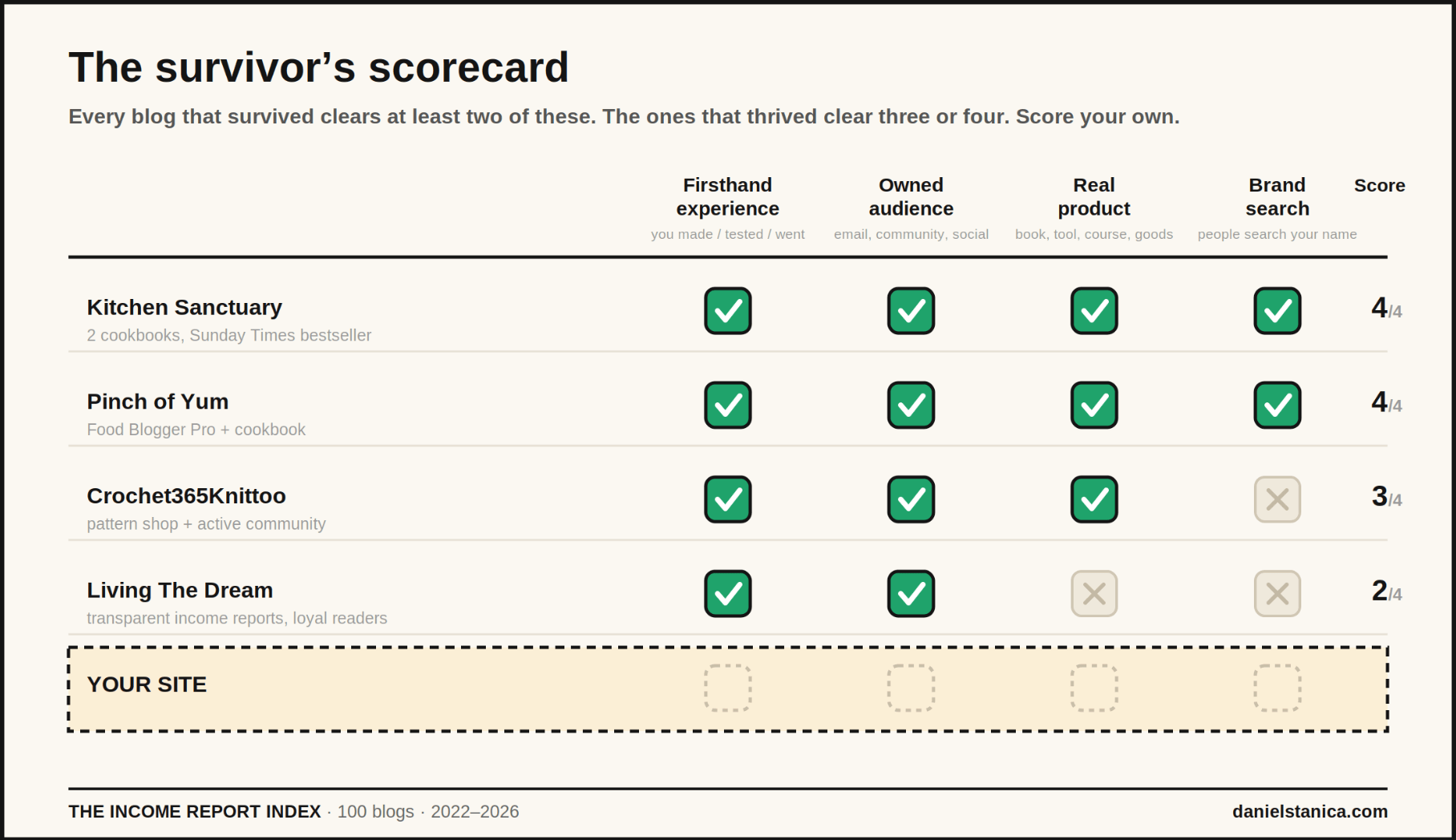
That’s three of the four survivor traits in one comeback: irreplaceable firsthand content, an owned audience, and brand demand. A Google correction helped, but they’d already made themselves recoverable. The sites that stayed dead had none of those traits to come back to.
So here is what to do about it.
📩 The next study lands in the newsletter first
MonetizeBetter is now newsletter-first: the research, the datasets, and the “here’s what I’d actually do” breakdowns go to subscribers before they’re ever public. If search is a melting asset (and the data above says it is), an email list is the audience you own. Start with mine.
If you’re considering starting a blog today.
Build only where value can’t be delivered to a reader via an AI summary without them needing you. That means demonstration over description: things you make, cook, test, build, or go to, documented with proof you actually did them.
Pick a niche where you have genuine firsthand experience or a credential, because Google’s Experience signal and AI citation engines now reward exactly that.
Also, assume from day one that search is a customer-acquisition channel, not a business, and that the business is the email list, the community, social media, or the product you convert that traffic into.
If your plan doesn’t include an owned audience by month six, you’re building a website that will be very difficult to monetize and grow.
If you’re holding a declining blog right now.
Triage it honestly against four options, in this order.
- Consolidate – Cut the thin, summarizable informational pages that no longer rank, and pour everything into the handful that demonstrate real experience; a focused 30-page site of genuine firsthand content beats a 500-page content farm on every signal that matters now.
- Convert – Whatever search traffic you have left is a melting asset, so spend it immediately to build an audience you own: aggressive email capture, a community, a YouTube channel, and a presence on Reddit and in forum threads that AI engines actually cite.
- Productize – If the audience trusts you, turn that trust into a product like a book, a tool, a physical or digital good, because the product-business archetype was the second most durable in this entire study and monetizes a relationship instead of a pageview.
- Sell – If none of the above is realistic for your asset, sell it while the traffic chart still shows something, because the next two updates won’t be kinder than the last four.
If you’re sitting on real brand equity.
This is the most underused position in the dataset. The independent sites that died had no brand search, meaning nobody typed their name into Google, while the survivors increasingly did.
If people search for you, you have something the algorithm and AI both treat as a trust signal, and almost nobody is deliberately building it. Put your name, your face, and your firsthand authority everywhere the citation engines look: structured first-party data and original benchmarks on your own site, video on YouTube (which now carries an outsized AI-citation and AI-Overview advantage), and genuine participation in the communities AI quotes. Treat it as a portfolio across surfaces, because any single one can be re-weighted overnight.
What to stop doing.
Stop publishing summarizable how-to content with no firsthand stake, as this category is the most exposed to both Google and AI, and it’s most of what this cohort published.
Be deeply skeptical of the two pivots the market is loudly selling: course-and-coaching funnels and “bolt an AI tool onto your blog.” They were the two worst-performing archetypes in this study, with the lowest median traffic and almost no growth. They’re lifeboats people climb into after the ship is already going down. They are not a way to keep the ship afloat.
Don’t fall for “win AI citations” as the next gold rush
Plenty of people are now selling AI visibility as the successor to the #1 ranking. Be careful. The traffic AI sends is even less ownable than the traffic from search. Semrush watched Reddit’s share of ChatGPT citations collapse from nearly 60% of responses to around 10% in roughly six weeks, then clawed back again as the model provider rebalanced the sources it leaned on.
AI visibility isn’t a ranking you earn and keep. It’s a portfolio position across surfaces you don’t control, re-decided continuously by the model providers. Build your whole business on it, and you’ve learned nothing from the 100 blogs above. (I work in AI visibility for a living — and I’ll still tell you that.)
FAQ
Are blogs dead in 2026?
Do blogs still make money in 2026?
How do AI Overviews affect blog traffic?
Can a blog recover from a Google core update?
What kind of blogs will still grow?
Conclusion
A blog’s traffic history is now a risk model. Entirely organic, summarizable niche, no owned audience, no brand search? That’s a melting ice cube, no matter how good last year’s numbers looked. This dataset is full of them.
Publish, rank, monetize clicks, repeat is dead. What replaced it: content nobody else can credibly make, sent to an audience you own, under a name people actually search for.
We learned that the hard way. This site is in the data.

![Top 100+ Blog Income Reports [Research]](http://monetizebetter.com/wp-content/uploads/2023/11/Blog-Income-Reports-Research-310x165.png)


Excellent research and a very insightful analysis. The shift from generic content to authentic, experience-based content is clear. Building a strong brand, creating original value, and growing an owned audience are essential for long-term blogging success. Thanks for sharing these valuable findings!